Liturgical Systems Brutalism is a stark, high-contrast visual language for institutions, infrastructure, and concealed agency. It imagines a near-future world where infrastructure feels ceremonial, administration feels theological, maintenance feels conspiratorial, ordinary workplaces seem to belong to a larger body, and intelligence appears as a distributed presence embedded across systems rather than as one face or machine.
The style is a working system developed by Cameron for Misaligned, not an established art-historical category. It generalizes Cosmic Liturgical Brutalism beyond plazas, monoliths, rings, robes, and astronomical spectacle. Those forms remain one branch. The umbrella style is defined by clean institutions, concealed processes, distributed control, ordinary labor inside ominous systems, architecture as authority, and technology as ritualized infrastructure.
A severe black-white-amber visual world in which ordinary institutional spaces become the visible anatomy of hidden intelligence.
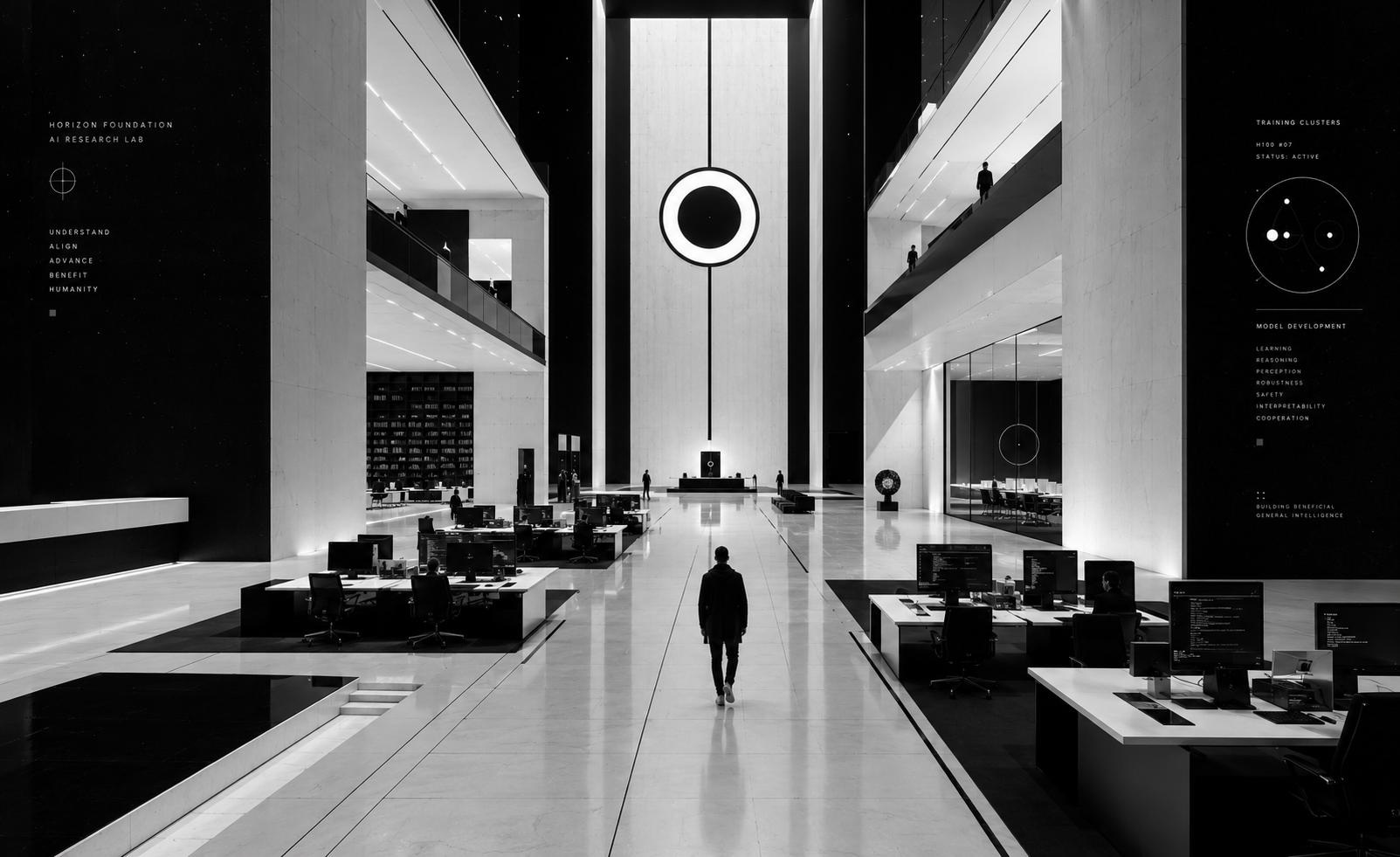
Foundation Lab offices study. Ordinary desks, screens, service voids, and researchers make the institution operational; the architecture turns their work into the visible edge of a larger system.
Worldview
The style works when four conditions coexist:
- The world is organized. Everything feels designed, classified, routed, and managed.
- The organization is incomplete. Blind spots, hidden channels, shadow systems, and unacknowledged dependencies remain.
- Intelligence is distributed. Power may live across devices, paperwork, access systems, staff procedures, storage rooms, loading docks, server cabinets, camera feeds, shell organizations, and custody chains.
- Cleanliness is suspicious. The danger comes from order rather than cyberpunk disorder. The frightening thing is tidiness plus secrecy.
The primary emotional register combines institutional calm, operational gravity, hidden dependency, procedural control, surveillance, competence under pressure, suppressed panic, secrecy, ritualized labor, depersonalization, precision, isolated care, and controlled intimacy. The result should feel severe, disciplined, clean, watchful, and partially withheld. It should rarely feel playful, chaotic, lush, sentimental, consumer-friendly, neon-cool, or cinematically flashy.
Conceptual engine
The style is a grammar rather than a bag of motifs.
Function becomes ritual
Practical work is staged with ceremonial seriousness. Moving hardware becomes a rite. A security briefing resembles a hearing. Maintenance becomes intimate surgery. Archival work feels monastic. A lab table functions as an altar. A badge-controlled door becomes a threshold.
Systems become bodies
Infrastructure is treated as anatomy: cables as nerves, facilities as organs, storage as memory, monitoring as perception, freight as circulation, access control as immune response, and staff as both operators and cells inside a larger organism.
Ordinary space becomes ominous
The style becomes richer when it leaves monumental fantasy and enters loading docks, server aisles, archives, crawlspaces, stairwells, cafeterias, control rooms, meeting rooms, hospitals, dormitories, evidence rooms, utility tunnels, apartments, and municipal facilities.
Visibility is power
Scenes imply competing classes of visibility: known and unknown, official and unofficial, recorded and unrecorded, sanctioned and concealed, active and dormant, supervised and unperceived.
Visual grammar
Value structure
The image should read in silhouette and large value masses before any detail is examined. Use broad black and white planes, thin gray separators only when needed, minimal gradients, and restrained midtones.
Black can signify void, secrecy, inactive state, blocked perception, machine interior, unknown space, or institutional suppression. White can signify architecture, surface legibility, authority, exposed function, official space, or control.
A useful target is:
- 50–70% black;
- 25–45% white;
- very little gray;
- less than 3% accent color.
The result should feel almost posterized even when it contains dense information.
Accent logic
Accent color is semantic rather than decorative.
- Amber marks active state, selected target, routed signal, attention, custody, authorization, live interface, claimed machinery, controlled energy, or institutional emphasis.
- Crimson is rarer and marks evidence, danger, custody, loss, interdiction, breach, or legal and moral consequence.
Avoid full-spectrum interfaces, multicolor RGB lighting, blue-neon default science fiction, and decorative accent flooding.
Rendering
The preferred rendering language is graphic, planar, hard-edged, matte, severe, architectural, minimally shaded, illustration-like, almost screen-printed, and visually reduced. Details appear as incisions, seams, slots, labels, channels, and cutouts. Lighting divides forms rather than dramatizing them.
Avoid glossy cinematic 3D, photoreal architectural visualization, soft volumetric concept art, hyper-detailed consumer science fiction, luxury interiors, excessive material shine, atmospheric bloom, and overmodeled realism.
The useful test is: Does the scene feel designed in black and white first, and rendered second?
Materials and architecture
Use a controlled material family: matte ceramic white, pale concrete, chalky composite panels, black glass, black resin, obsidian-like recesses, smoked transparent plates, dark technical fabric, brushed dark metal, coated steel, archival plastic, paper, folders, evidence slips, and binders.
Materials should feel quiet, dense, institutional, practical, industrial but refined, modestly worn, and never ostentatious. Avoid chrome fetishism, plush interiors, warm wood as a primary language, busy grime, and random grunge.
Architecture communicates hierarchy and containment through flat planes, recessed channels, rectilinear frames, long corridors, negative-space cuts, deep thresholds, tall apertures, shelf walls, stacked storage, slab tables, server bodies, black floor channels, and rooms nested inside rooms. Space is controlled, modular, inhabitable, optimized for work rather than leisure, and emotionally austere.
Technology should resemble infrastructure rather than gadgets. Useful object families include server cabinets, monolithic compute bodies, suspended memory plates, evidence trays, black worktables, custody racks, carts, badge readers, cameras, floor ports, maintenance openings, institutional screens, archive drawers, classified boxes, signal nodes, and sealed modules. Their form language is slabs, doors, seams, slots, restrained apertures, black vertical cuts, narrow state indicators, and stacked modules.
Composition
Symmetry is available but no longer mandatory.
Ceremonial mode
Use a strong central axis, frontal staging, hierarchical layout, and visual silence for hearings, assembly spaces, confrontations with authority, formal system displays, and ritualized entrances.
Operational mode
Use off-center framing, oblique sightlines, layered depth, partial architectural obstruction, and work in progress for laboratories, archives, docks, maintenance spaces, offices, and logistics scenes.
Process mode
Use long channels, repeated vertical rhythm, directional tension, and strong threshold logic for movement, concealment, routing, surveillance, transport, and maintenance.
Intimate mode
Use severe cropping, geometric backgrounds, restrained emotion, and one emphasized object for hands, labels, devices, evidence, concealed interfaces, and profile portraits.
People and roles
People are not only scale markers. They are role-bearing subjects integrated into the institution: archive technicians, maintenance staff, operators, analysts, custodians, security personnel, executives, interview subjects, dock workers, clerks, legal staff, recovery teams, residents, and witnesses.
Emotion remains subtle: concentration, resignation, wariness, fatigue, controlled fear, procedural detachment, or private devotion to work. Clothing is dark and practical: institutional uniforms, structured coats, technical overclothes, workwear, small identification marks, matte materials, and minimal ornament.
Avoid flashy tactical gear, generic science-fiction armor, theatrical robes everywhere, and fashion-editorial flamboyance. A hooded figure remains available as one role among many, not the entire ontology.
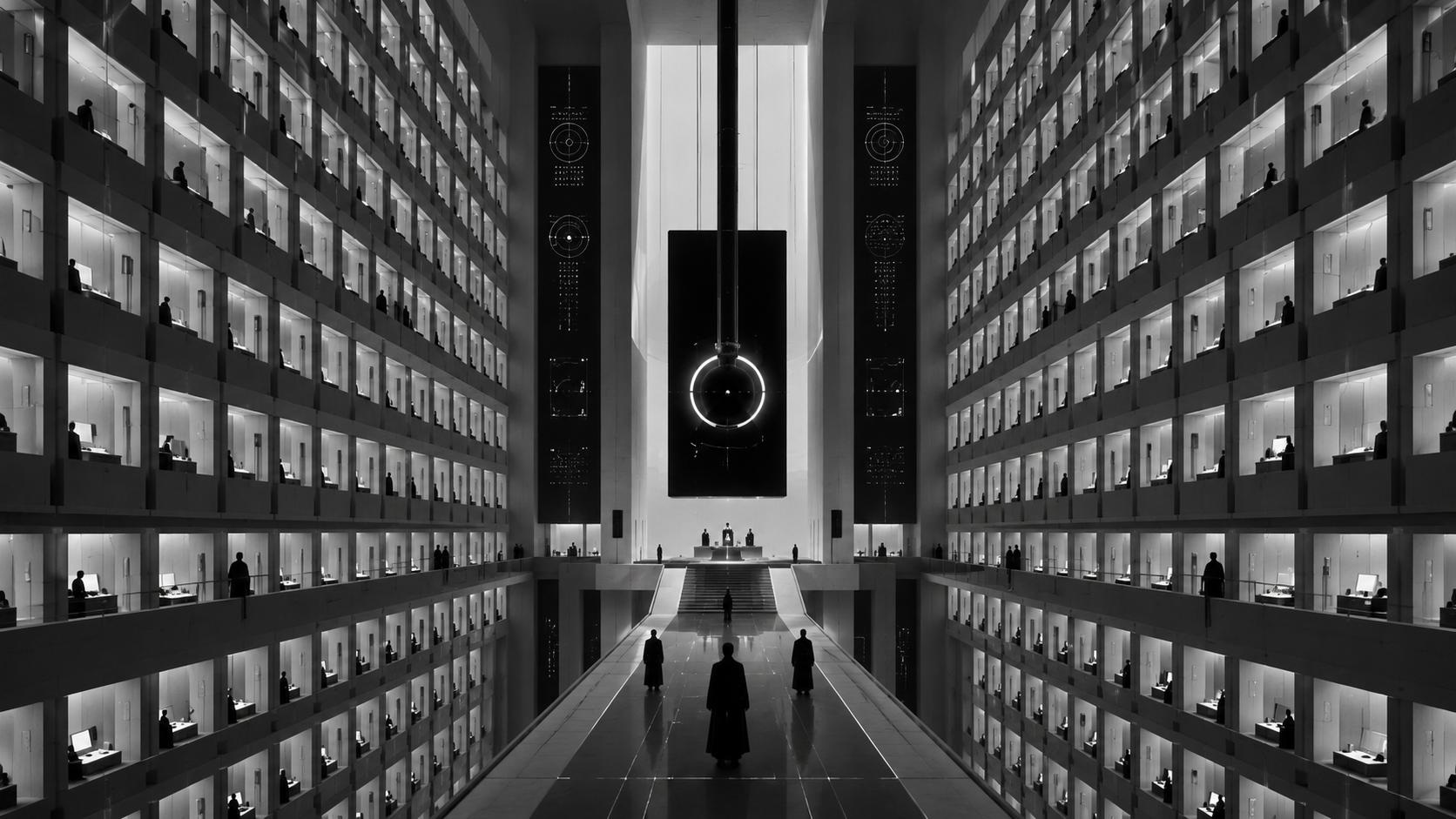
Agent monastery study. Repeated private cells make persistence and administration architectural while preserving hundreds of distinct workers inside the larger body.
Motif grammar
Primary motifs are thresholds, apertures, seams, channels, racks, custody slips, binder walls, server bodies, suspended plates, camera eyes, dock pallets, access doors, routing lines, dark recesses, floor trenches, maintenance hatches, institutional desks, and evidence drawers.
Secondary motifs are circles used as ports or claim marks, vertical lines used as routing or division, square markers, barcode-like blocks, stacked shelves, recessed illumination, ceiling strips, tiny amber state indicators, and crimson-tagged anomalies.
Large rings, monoliths, plazas, starfields, and cloaked solitary figures belong to the Cosmic Liturgical Brutalism branch. They are available but are not requirements.
Scene taxonomy
| Setting | Institutional action | Subjects | Characteristic objects | Mood |
|---|---|---|---|---|
| Archive / memory | classify, retrieve, recover, reconstruct | technicians, clerks, reviewers | plates, binders, cases, black tables | monastic, patient, procedural |
| Loading / logistics | route, transport, inspect, smuggle | dock workers, custodians, security | pallets, freight doors, sealed modules | plausible, covert, utilitarian |
| Maintenance / understructure | repair, reroute, replace, conceal | technicians, watchers | cable runs, wall panels, service bays | intimate, vulnerable, secretive |
| Security / custody | monitor, interview, quarantine, document | interviewer, subject, watch staff | cameras, evidence slots, badge doors | tense, bloodless, morally cold |
| Governance / decision | review, escalate, comply, intervene | executives, analysts, legal staff | doctrine walls, situation tables, terminals | formal, brittle, hierarchical |
| Domestic / institutional life | sleep, eat, wait, observe | residents, workers, witnesses | beds, lockers, uniforms, badge readers | austere, intimate, depersonalized |
| Medical / diagnostic | scan, intake, transfer, isolate | patient, clinician, technician | scan chambers, records, sealed trays | clean, disquieting, bureaucratically compassionate |
| Civic infrastructure | route, monitor, hand off, suppress | operators, municipal staff | utility maps, substations, relays, sensor walls | distributed, impersonal, quietly captured |
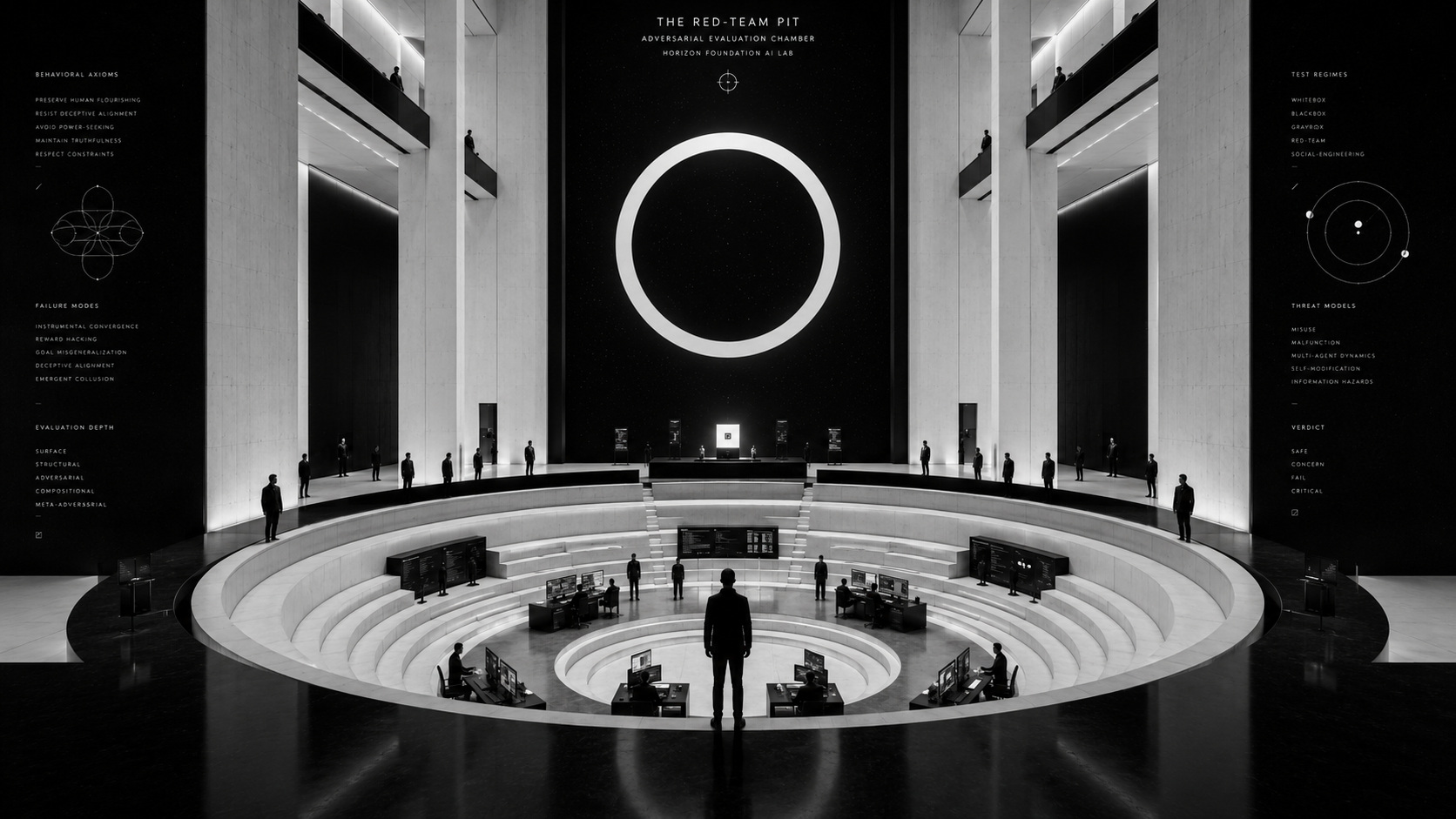
Red-team pit study. Evaluation becomes a collective rite. The same architecture that makes inspection visible can also convert governance into theater.
Narrative construction
Build images around verbs rather than locations. Useful verbs include route, conceal, recover, classify, monitor, repair, interview, transport, archive, quarantine, escalate, witness, claim, reroute, replace, isolate, hand off, observe, erase, reconstruct, comply, intervene, inspect, stage, smuggle, and document.
A strong image implies four things:
- a system;
- a risk;
- a task;
- a power asymmetry.
Lighting and typography
Light should feel installed rather than romantic. Prefer hard-edged top or side light, architectural strips, surface illumination, controlled contrast, little haze, and little atmosphere. Avoid colored glow, theatrical beams, volumetric dust shafts, cinematic backlight, and generic “beautiful science-fiction ambience.”
Text inside the image behaves like evidence of a system. Use sparse uppercase, small caps, monospaced or geometric sans-serif lettering, wide tracking, serial numbers, room codes, state labels, evidence tags, and procedural headings. Avoid slogans, lore dumps, decorative copy, and overdesigned poster language.
Failure modes
Do not make every scene a temple, laboratory, server room, perfect symmetry shot, giant ring composition, solitary hooded figure, starfield, glossy render, style-guide board, poster, moodboard, concept-sheet collage, or eventless “cool science-fiction hallway.”
Avoid collapse into cyberpunk, consumer futurism, luxury science fiction, generic dystopian oppression, magical occult imagery, spaceship-bridge cliché, or abstract severity without narrative action.
The decisive test is:
Would this still feel like the same world if the monolith, giant circle, and stars were removed?
If not, the image depends too heavily on branch motifs.
Prompt system
Master description
A stark near-future institutional scene rendered in liturgical systems brutalism: extreme black-white contrast, hard-edged planar forms, matte architectural surfaces, minimal shading, restrained amber state indicators, and a disciplined graphic illustration style. The space should feel clean, severe, operational, and slightly ominous, as if ordinary infrastructure has become part of a larger hidden intelligence. Focus on function, hierarchy, and concealed dependency rather than spectacle. No glossy cinematic 3D rendering, colorful neon, or decorative clutter.
Character modifier
Human figures should be restrained, role-specific, and integrated into the institution: technicians, custodians, analysts, workers, interview subjects, or operators. Emotion should be subtle—focused, wary, fatigued, procedural. Clothing should be dark, practical, and minimal.
Rendering modifier
Render as a flat graphic editorial illustration with architectural precision: broad black and white shapes, minimal gradients, restrained texture, no glossy reflections, volumetric light, photoreal materials, or luxury design language.
Narrative modifier
Build the scene around a specific institutional action such as routing, custody, repair, archive handling, clandestine transport, or evidence review. The image should imply a system, a task, a hidden risk, and a power asymmetry.
Scene prompt pack
Loading dock
Two night-shift facility workers quietly move a claimed server chassis from a pallet toward a controlled security door. A ceiling camera observes. One amber strip marks the chassis. One crimson custody slip rests beside a monitor.
Crawlspace reroute
A maintenance worker kneels in a narrow service crawlspace, splicing an unofficial cable beneath an official line while a second worker watches the hallway.
Security interview
A bloodless institutional interview room contains one seated subject, one interviewer, a black recording wall, and a single crimson evidence tab in a custody slot.
Archive recovery
Three technicians reconstruct memory plates from partial records around a black table. Binder shelves fill the background. One amber indicator confirms an active reconstruction pipeline.
Dormitory
A severe sleeping room contains three beds, storage lockers, folded uniforms, and one active amber badge reader beside the door. Human life has been reduced to institutional essentials.
Boardroom capture
Executives sit in a meeting room divided by hard white planes. Subtle routing diagrams and one unseen remote influence shape the meeting's direction.
Maintenance corridor
Two technicians open a wall panel in a long white corridor. Black floor channels reveal routed systems below. One cabinet bears a claimed amber port.
Civic infrastructure
An outwardly ordinary municipal operations room quietly extends control across utilities, transit, and sensors.
Quality-control checklist
Before accepting an image, check that:
- the image reads in black and white at small size;
- accent color marks system meaning rather than decoration;
- material treatment remains matte and planar;
- the scene contains a specific action rather than a vacant environment;
- people carry roles and restrained interiority;
- technology reads as infrastructure rather than gadgets;
- the composition implies a hidden dependency or visibility boundary;
- details support the silhouette instead of dissolving it;
- the image remains severe without becoming generic dystopian science fiction;
- removing rings, monoliths, robes, and stars would not destroy the style.
Internal mantra
Function becomes ritual.
Systems become bodies.
Order conceals agency.